

2026 Update: Data Summary
This revision distinguishes between traditions, cosmetic or food uses, and results that have been genuinely studied. A study on an extract or an isolated ingredient does not automatically demonstrate the effectiveness of the finished product.
Precautions: The benefits presented are cosmetic, sensory, or traditional. Results vary depending on the formulation; perform a skin test and follow the label.
References consulted: source 1.
Because a handmade pair isn't chosen quite the same way as a factory pair.
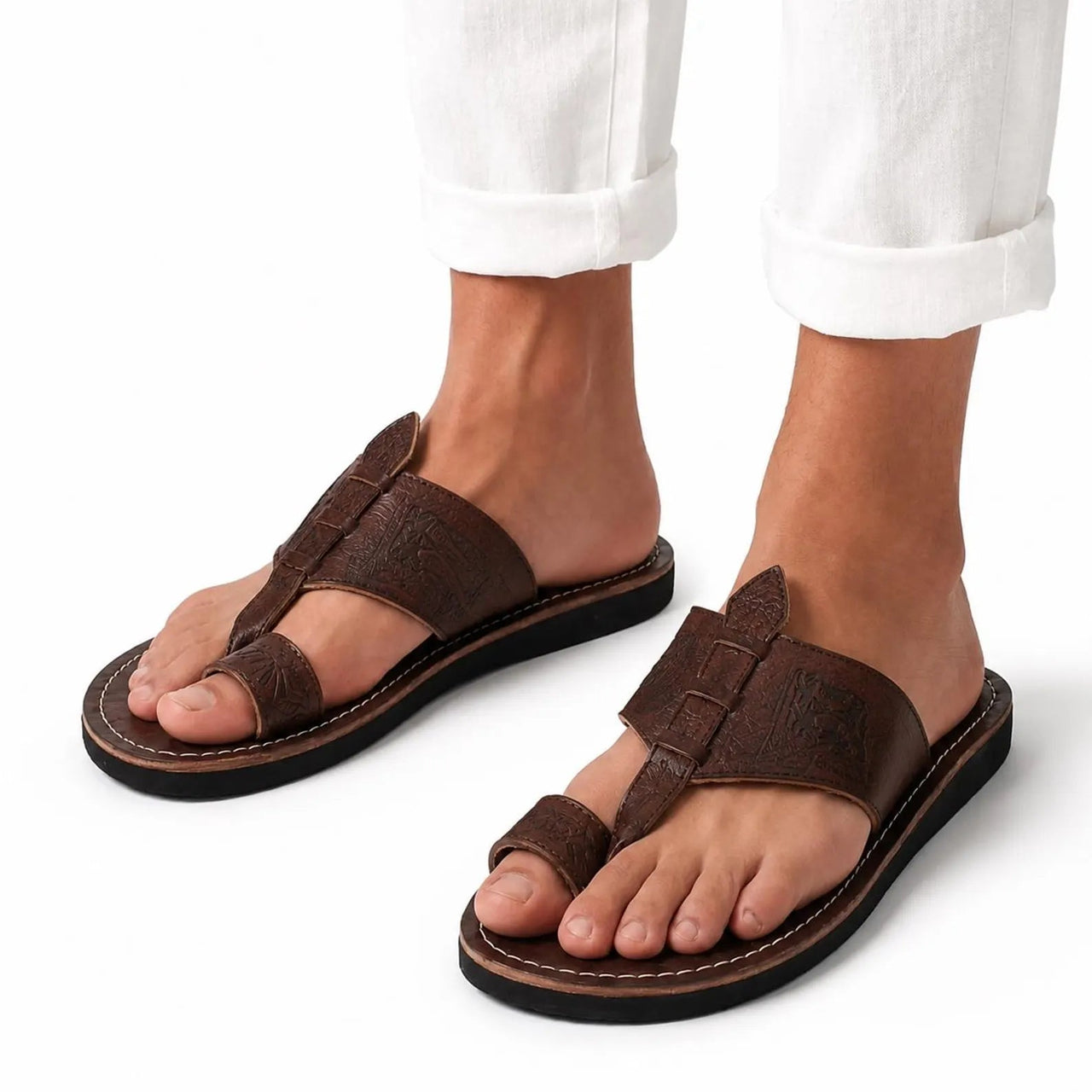
Genuine leather sandals, Yamiriam workshop.
In a Moroccan workshop, no two pairs of sandals ever turn out exactly the same. Leather has its own thickness, its own suppleness, its own grain—and it is precisely this irregularity that makes all the difference compared to a mass-produced pair. But it poses a very concrete question when ordering online: how can you be sure to get the right size without having been able to try them on?
This is the question we are asked most often, and that's a good thing: it means you are taking your future purchase seriously. Here is how, without jargon, to measure your foot, read a size chart, and understand the little nuances of genuine leather before placing your order.
“Very good, please order one size up. I wear a 44 and it fits me just right, down to the millimeter.” — Manish, Yamiriam customer, Berlin
The measurement ritual
No need for a tailor's tape measure or an app: a sheet of paper, a pencil, and five minutes are enough.
- Place the paper on the floor, against a wall. Place your foot on it, with your heel firmly against the wall.
- Trace the outline. Holding the pencil vertically, mark the furthest point of your foot — often the big toe, sometimes the second one.
- Measure the total length. From the wall to the furthest mark, in centimeters.
- Repeat the measurement at the end of the day. Your foot swells slightly after several hours on your feet — this is the measurement, the most generous one, that you should keep.
Reading the size chart
Once you have your measurement, refer to the table corresponding to your model. EU, UK, and US systems do not follow the same numbering logic—hence the advantage of always starting from the length in centimeters rather than a "usual size," which can vary from one brand to another.
| Foot length | EU | UK | US |
|---|---|---|---|
| 22.5 cm | 35 | 2.5 | 5 |
| 23.2 cm | 36 | 3.5 | 6 |
| 23.8 cm | 37 | 4.5 | 7 |
| 24.5 cm | 38 | 5 | 7.5 |
| 25.1 cm | 39 | 6 | 8.5 |
| 25.8 cm | 40 | 6.5 | 9 |
| 26.4 cm | 41 | 7.5 | 10 |
| Foot length | EU | UK | US |
|---|---|---|---|
| 24.5 cm | 39 | 6 | 6.5 |
| 25.1 cm | 40 | 6.5 | 7.5 |
| 25.8 cm | 41 | 7.5 | 8 |
| 26.4 cm | 42 | 8 | 8.5 |
| 27 cm | 43 | 9 | 9.5 |
| 27.8 cm | 44 | 9.5 | 10.5 |
| 28.5 cm | 45 | 10.5 | 11 |
| 29 cm | 46 | 11 | 12 |
Leather has memory

A pair made of genuine leather does not behave like a synthetic pair. The leather breathes, it gradually adapts to the shape of the foot, and it stretches very slightly during the first few days of wear—especially when worn barefoot, as is often the case with summer sandals.
In practical terms, this means two things. First, that a pair that seems "snug" upon arrival will, after a few outings, be more comfortable than during the initial try-on. Second, and this is the important point: if your measurement falls exactly between two sizes, it is better to round up. A pair that is slightly loose can be managed with an adjusted strap or a thin sock; a pair that is too small, however, will never stretch enough to become comfortable.
What about closed models or ankle boots?
The rule changes slightly: for closed models, such as Berber ankle boots, we recommend on the contrary to stay as close to your exact measurement as possible, or even to stick to your exact size—the leather will stretch with use, but a closed model that is too big at the start will tend to rub at the heel before it settles.
Frequently asked questions about sizes
I am between two sizes, which one should I choose?
For open models (sandals, mules), opt for the larger size. For closed models (ankle boots, closed babouches), stick to your exact size.
Do you offer custom sizes?
Yes. If no standard size suits you, contact us before ordering: we can adapt the size on request.
Do the men's and women's models follow the same chart?
No, each chart above corresponds to a different fit. Always refer to the chart of the model you are purchasing.
What if the size doesn't fit upon arrival?
Consult our exchange policy—we offer exchanges on the majority of models. Contact our customer service team with your order number.
One last thing: if you have the slightest doubt after measuring your foot, simply write to us. It is often faster to decide together than to guess alone in front of a chart.


